Car Rush 3D: Speed Legend – A Pocket-Sized Arcade Racer That Respects Your Thumb
In a market flooded with hyper‑casual tire‑burners and sim‑lite wannabes, Car Rush 3D: Speed Legend takes a lean‑back approach to speed that manages to feel both familiar and refreshingly mindful. Developed by the modest studio Rushy Games (known for their previous traffic‑dodging titles), this title is best described as a one‑thumb arcade racer that prizes flow state over flashy graphics. Its main hooks include a twist‑on‑a‑dime drift system, a “rhythm‑based” boost mechanic, hundreds of unlockable vehicles, and a surprisingly sticky progression loop. The game targets casual commuters, short‑burst players, and anyone who misses old‑school arcade racers but wants something that works on a five‑year‑old phone. Let's get into the nitty‑gritty.
The Opening Bend – Why You Should Care
You know that feeling when you're waiting for your coffee, or stuck in an actual traffic jam, and you just want to go? Car Rush 3D understands that itch. The first time I swiped left to avoid an oncoming SUV, the car didn't just jerk – it eased into a controlled slide, like a dancer who knows the floor is slippery. That little moment of tactile feedback told me this wasn't another mindless “tap to dodge” clone. It's a racer that wants you to feel the asphalt, even if your only input is a finger on glass. Over the next week, I found myself reaching for it during elevator rides, train delays, and – let's be honest – bathroom breaks. And it never felt like a chore.
Core Mechanics – Beyond the Tap
1. Adaptive Drift: Not All Turns Are Created Equal
Most mobile racers handle like they're on rails: you swipe, the car snaps to a lane, end of story. Car Rush 3D's drift system is different. Each vehicle has a drift radius that responds to both your swipe speed and the angle of the turn. Instead of a binary “left/right”, you can feather your finger – a quick flick gives a sharp chicane drift; a long, gentle sweep produces a wide, sweeping curve perfect for maintaining speed. This isn't a gimmick; it's the core of the game. Early levels teach you to “feel” the track's curvature, and by the time you hit the first boss race, you're instinctively modulating your swipes like you're turning a real steering wheel. The learning curve is gentle but satisfying: you'll fail a few times before the muscle memory clicks, but when it does, every perfect drift feels earned.
2. Rhythm Boost: Tapping to the Engine's Beat
The other standout feature is the rhythm‑based boost. Instead of a simple nitro button, your boost meter fills when you chain drifts without breaking traction. But here's the twist: once the meter is full, you tap to boost, but the boost lasts only as long as you keep tapping in sync with a subtle, engine‑pulse visual cue. Miss the beat, and boost cuts short, leaving you vulnerable. This turns a frantic race into a mini‑game of focus – you're balancing drift inputs with rhythmic taps, all while dodging traffic. It's surprisingly meditative, like a runner syncing their breath to their stride. The mechanic gates speed behind skill rather than pay‑to‑win widgets, which I deeply appreciate.
User Experience – Smooth Roads and a Few Pebbles
Interface & Visuals
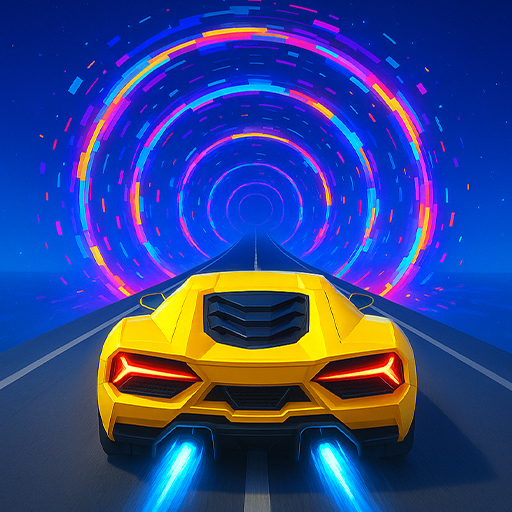
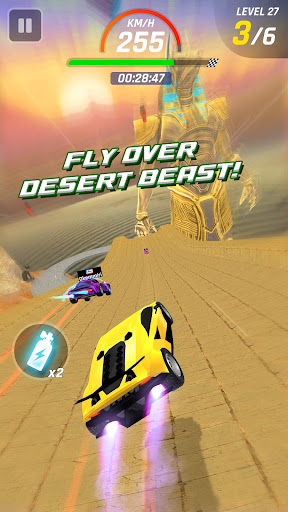
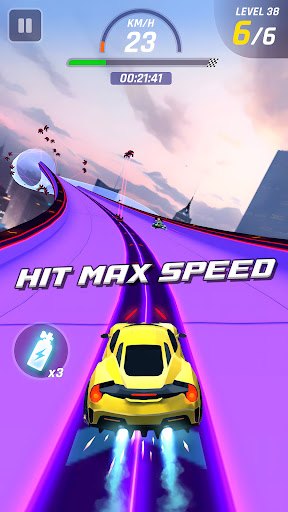
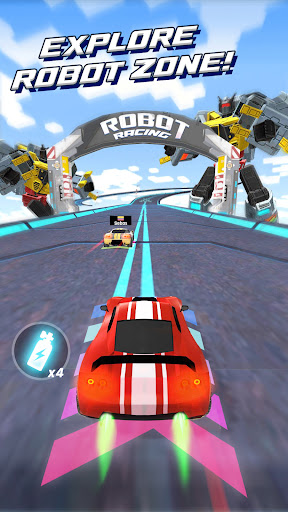
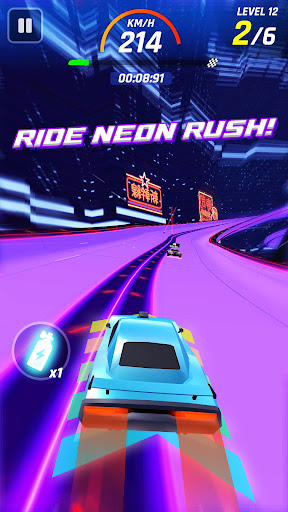
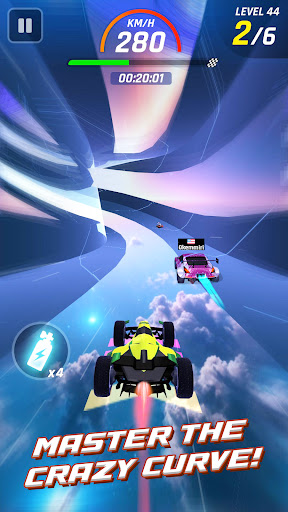
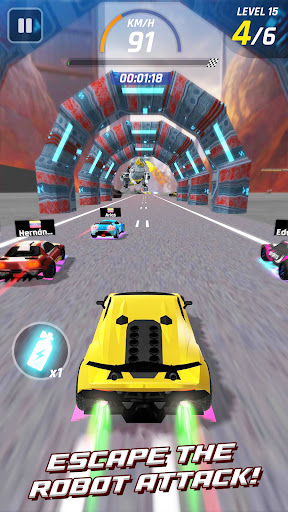
The UI is minimalist to the point of being almost bare: a tiny speedometer in the corner, your boost bar below the car, and a “pause” button. No ads plastered over the track (they pop only between races). The art style is clean, low‑poly 3D with saturated colors – think Ridge Racer meets Crossy Road. It's not pushing graphical boundaries, but it runs at a rock‑solid 60 fps on mid‑range Android and iOS devices. The only hiccup? Some menu text is a bit small on older phones, but that's a minor gripe.
Learning Curve
New players can finish their first race without drifting once. The game gently introduces mechanics through a “tutorial‑lite” approach: each new track has a tiny overlay that says “swipe harder for a sharper turn”. You won't be overwhelmed. However, mastering the drift‑boost rhythm takes about 2–3 hours of play. That's a sweet spot – not too punishing, not too shallow.
Differentiation – What Sets It Apart from the Pack
Vehicle Handling Differentiation
Unlike many arcade racers where all cars feel the same (just reskinned), Car Rush 3D assigns each vehicle a distinct drift angle multiplier and traction recovery speed. A muscle car slides wide and recovers slowly, forcing you to anticipate corners earlier. A nimble hatchback can change lane instantly but loses speed on long curves. This means you'll gravitate toward certain cars for certain track layouts. For example, the “Serpentine Pass” track with its tight S‑bends rewards the agile “Swift GT”, while “Coastal Sweep” favors the “Thunder V8” for its ability to carry momentum through long arcs. This variety keeps grinding for new cars meaningful, not just cosmetic.
Track Design Memorability
Most mobile racers generate endless procedural highways that all look the same. Car Rush 3D's tracks are hand‑crafted with distinct visual landmarks and rhythm patterns. Each track has a “signature segment” – a bridge that narrows, a tunnel that forces you to line up a boost in the dark, a sharp hairpin preceded by a long straight where you can build boost. After just three runs, you can close your eyes and visualize the sequence of turns on “Sunset Drift”. That memorability makes repeated runs feel like improving your lap, not random survival. It's a small touch that shows the developers respect your time.
Final Verdict – Who Should Download This (and When)
Highly recommended for: Anyone who enjoys other arcade racers but wants something that doesn't require constant attention. The adaptive drift and rhythm boost create a satisfying feedback loop that respects your skill without demanding hours of daily practice. Use it for: short commutes, queue‑waiting, or winding down after a long day. Avoid if you crave realistic physics, detailed car customization, or competitive multiplayer – this is a solo, cathodic experience.
One small caveat: The game includes a stamina system (five races before a 15‑minute cooldown, or you watch an ad). It's not aggressive, but it's there. The good news? The flow is so focused that you'll probably be happy to take a break anyway.
In a world of hyper‑monetized slot‑machine racers, Car Rush 3D: Speed Legend is a genuine piece of game design. It knows you're busy, and it respects you enough to give you a tight, polished experience that's over before you've burned your toast. Give it a spin – your thumb will thank you.